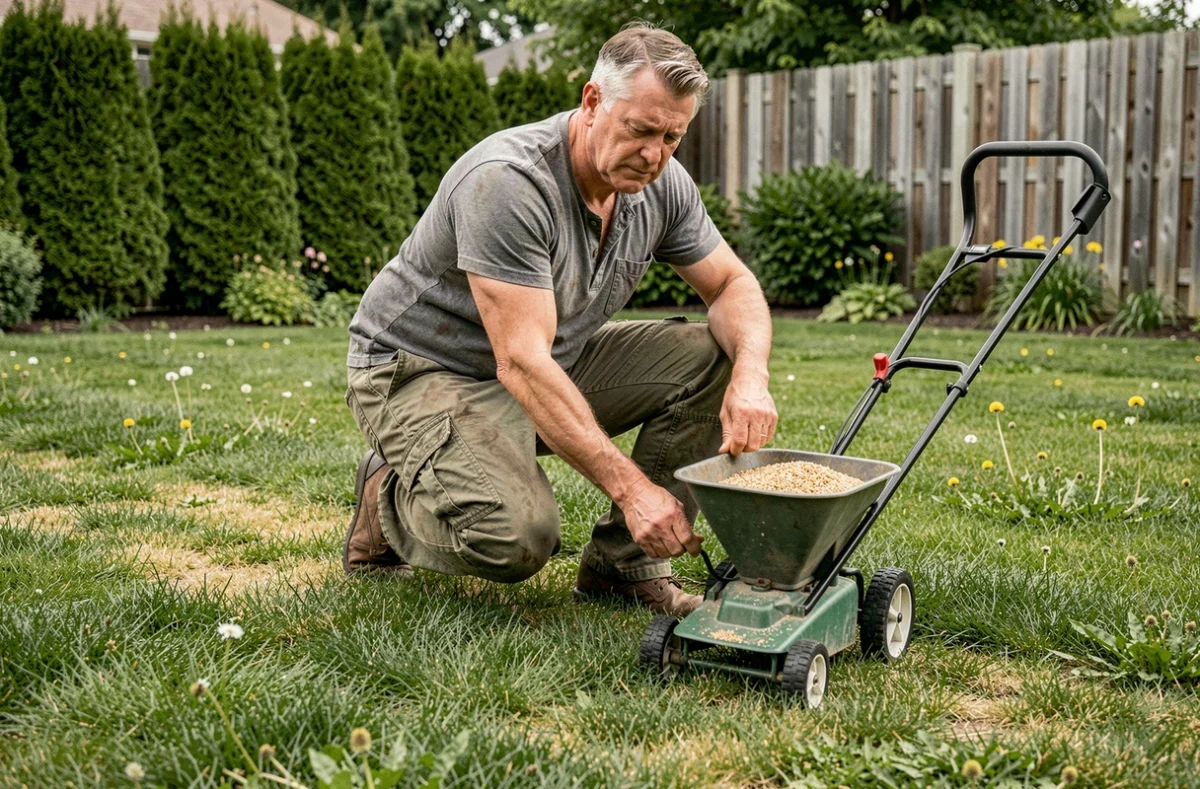
On a freshly mowed lawn the day before, the white clover we wanted to eliminate shows almost no leaves. We spray the selective herbicide, the product runs off the stubs of petioles, and three weeks later the rosettes are still there. The issue does not lie with the product, but with the sequence chosen between mowing and treatment.
Why leaf area affects the effectiveness of selective herbicides
A selective herbicide for lawns based on MCPA, 2,4-D, or dicamba penetrates through the leaves of weeds. The product crosses the cuticle, enters the sap, and migrates to the roots. The larger the exposed leaf area, the higher the absorbed dose.
When we mow just before treating, we remove part of this contact surface. Rosette weeds (dandelion, plantain, daisy) lose their most developed leaves. Creeping clover retains more low vegetation, but the close cut still reduces the absorption area.
Conversely, mowing too soon after spraying physically removes the product before it has had time to penetrate the cuticle. Systemic formulations require several hours of leaf contact to be effective. This helps us understand why the answer is not simply “before” or “after,” and why knowing the ideal order for treating the lawn on Clic Garden prevents wasting an entire spraying pass.
Mowing delay before and after selective treatment: what margin to respect
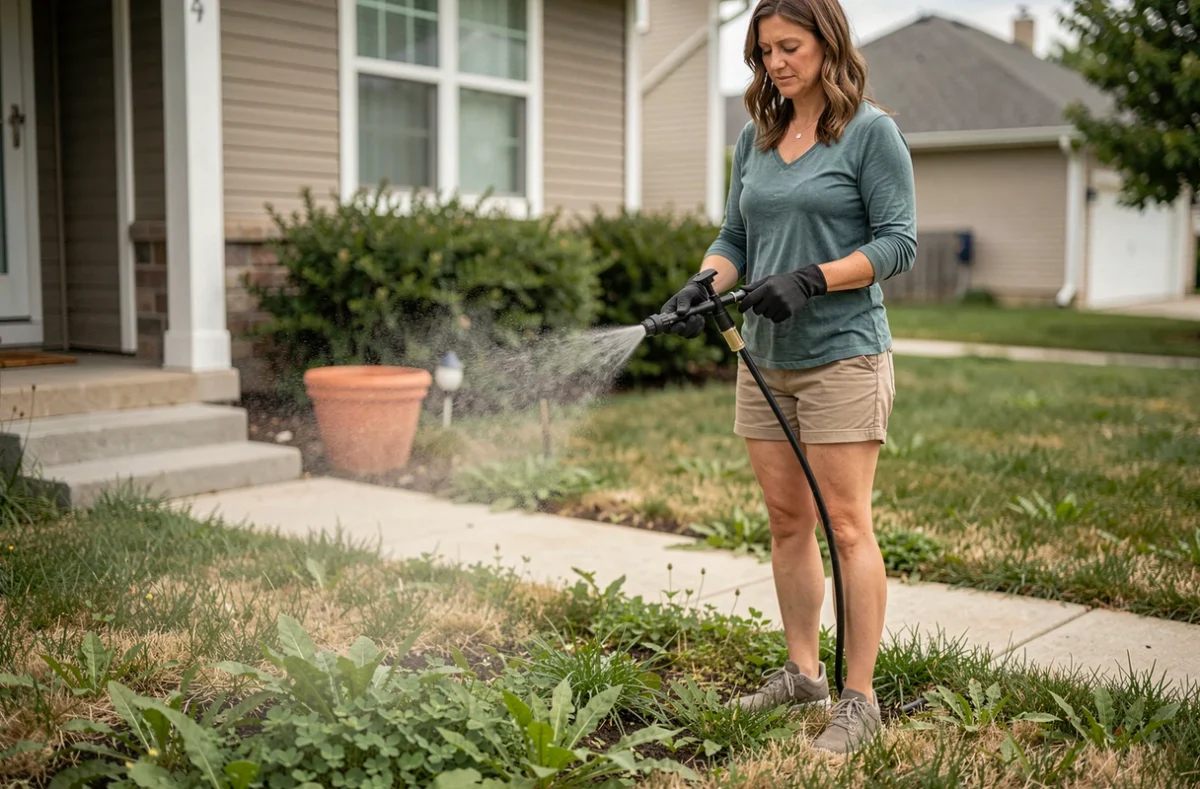
Most labels of “three-way” selective herbicides (combining two or three active ingredients) recommend an interval of about two to three days without mowing, both before and after application. This delay allows weeds to reform sufficient foliage before treatment, and then gives the product time to migrate into the tissues after spraying.
In practice, we follow a simple sequence:
- Mow to the usual height, without scalping, then wait two to three days for the weeds to redeploy their leaves.
- Spray the selective herbicide on dry foliage, with no wind, following the dose indicated on the label.
- Do not mow for at least two to three days after application, to avoid removing the product or disrupting its migration to the roots.
The no-mow window frames the treatment on both sides. Ignoring it means reducing the effective dose without changing the applied dose, which encourages regrowth and may select for more resistant weeds.
Mowing height before treatment
Avoid cutting lower than the standard mowing height for the lawn. Scalping exposes the crown of the grasses and further reduces the foliage of creeping weeds. It is better to slightly raise the blade if the lawn is already short, to maintain maximum leaf area on the weeds without allowing the grass to grow excessively.
Compatibility between grasses and active ingredients: the overlooked factor
Before focusing on the mowing schedule, it is essential to check that the chosen product is suitable for the grass species in place. Not all grasses tolerate the same active ingredients. A mixture containing dicamba may work without damage on perennial ryegrass but cause burns on more sensitive varieties, especially if the ambient temperature is high.
The product label lists compatible species and the temperature range for use. Exceeding this range increases the risk of phytotoxicity on grasses, regardless of the timing of mowing. Feedback on this point varies by region and the mixtures sown, but the reflex to read the entire label remains the best protection.
Recently seeded or overseeded lawn
A lawn less than three months old should generally not receive selective treatment. Young seedlings have not yet developed a root system capable of tolerating the active ingredients. Regular mowing and appropriate fertilization remain the best levers against weeds on a recent sowing. We wait until the lawn has been mowed several times before considering a herbicide application.
Perennial bulbous weeds: when mowing alone is not enough
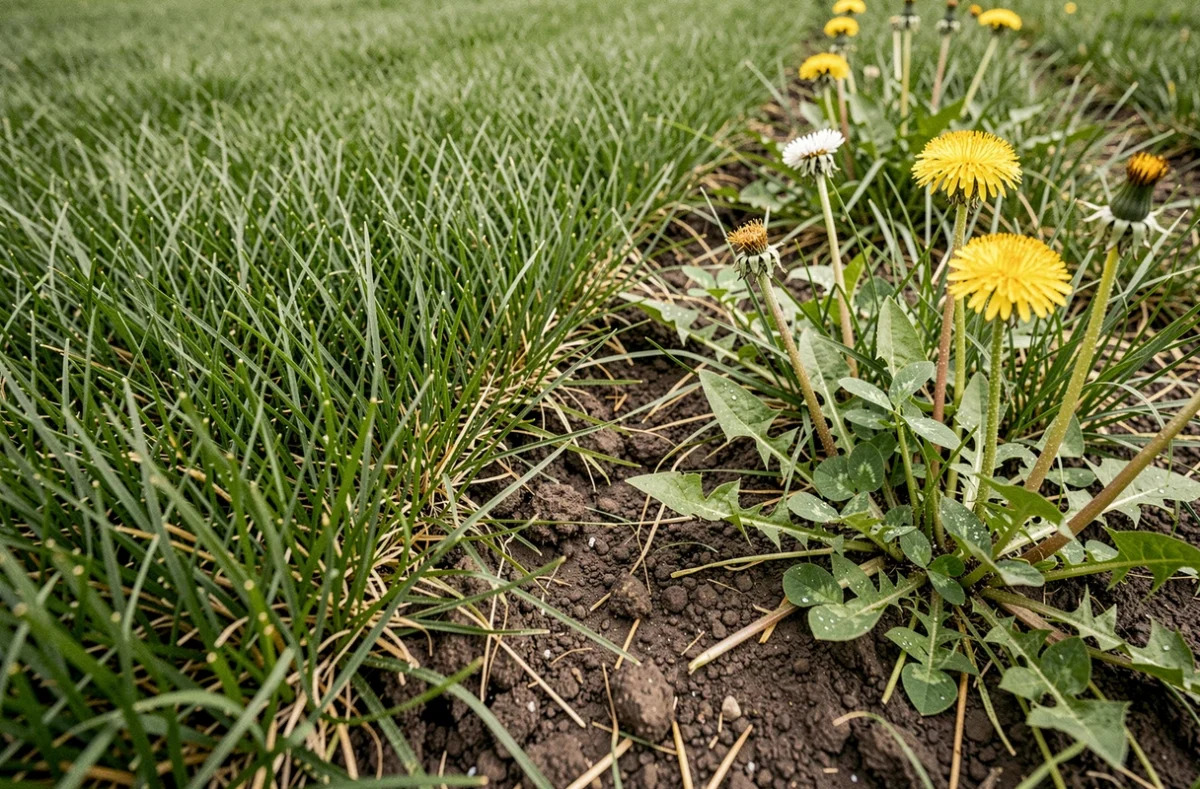
Dandelion or clover are classic targets for selective weeding, but some weeds pose a different problem. Wild garlic or wild onion, for example, survive thanks to underground bulbils. Mowing only removes the visible part, without affecting the survival organ.
For these species, the treatment must target the foliage when it is most developed, that is, before mowing removes it. Allow the leaves to grow sufficiently to provide maximum absorption surface, then spray. Mowing occurs afterward, once the waiting period is respected.
This reasoning based on the survival organ (bulb, rhizome, taproot) changes the strategy: we no longer schedule mowing for aesthetics but to increase contact between the product and the target plant.
Weather conditions and time of day for treating the lawn
The choice of application window is as important as the timing relative to mowing. A few conditions to respect:
- Dry foliage at the time of spraying: morning dew dilutes the product and reduces adherence to the cuticle.
- No rain expected in the hours following application: rainwater washes the product away before complete absorption.
- Light wind, to avoid drift to flower beds or the neighboring vegetable garden.
- Moderate temperature, within the range indicated on the label: excessive heat increases product volatilization and the risk of burning on grasses.
Applying at the end of the day, when the wind dies down and the sun declines, often offers the best compromise. The product remains in contact with the foliage all night, without thermal stress.
The question “before or after mowing” is only relevant if the rest of the protocol is followed. A selective treatment applied to wet foliage, in strong wind, just before a storm, will fail even with perfect mowing timing. It is more beneficial to respect the entire sequence (mow, wait, spray at the right time, wait, then mow again) than to focus on a single link.