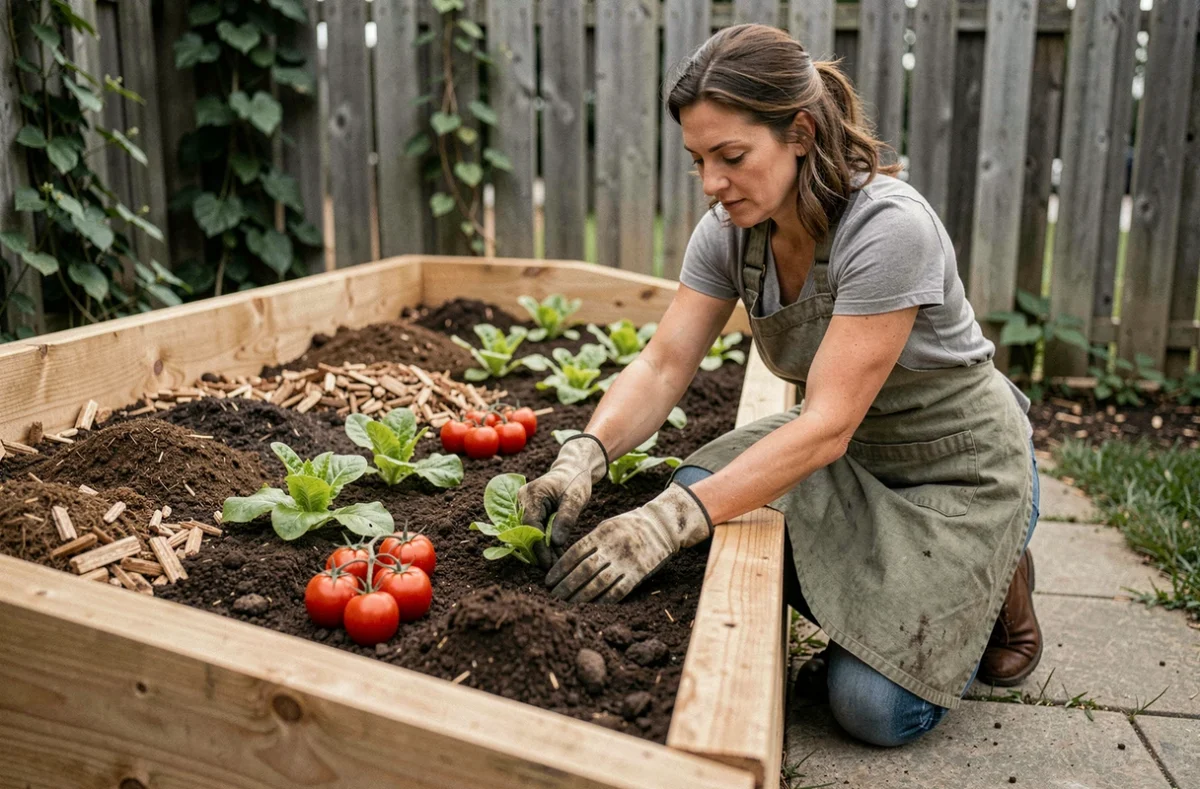
A raised garden bed installed on a terrace or clay soil does not fill up like a box placed directly on sandy soil. The substrate, its thickness, and the way we layer the materials directly influence the vigor of the vegetables and the lifespan of the bed. Properly filling a raised garden bed means anticipating drainage, water retention, and fertility over several seasons, not just the first year.
Drainage and drying out of the raised garden bed: the underestimated trap
It is often thought that elevation solves humidity problems. This is true for waterlogged soils in winter, but the downside is real: a raised bed dries out much faster than a bed at ground level. The study by Wilton et al. (2023) on the microclimate of garden beds confirms that elevation increases watering needs during dry periods.
Before filling, it is beneficial to ask the question differently. If the soil is naturally well-drained, the bottom layer (gravel, clay balls) often recommended everywhere becomes counterproductive: it accelerates evaporation without addressing a problem that does not exist. It should be reserved for heavy soils or bottomless beds placed on slabs.
To limit drying out, a thick mulch on the surface remains the most reliable solution. Detailed advice on the composition of the layers is available on the La P’tite Graine website, with variations depending on the depth of the bed.
Filling layers: creating fertile soil without wasting compost
The layering method (lasagna) works well in a deep raised bed. We stack coarse organic matter at the bottom, then increasingly finer materials towards the top. The goal is twofold: to create a reservoir of nutrients that are released slowly and to avoid filling the entire volume with expensive potting soil.
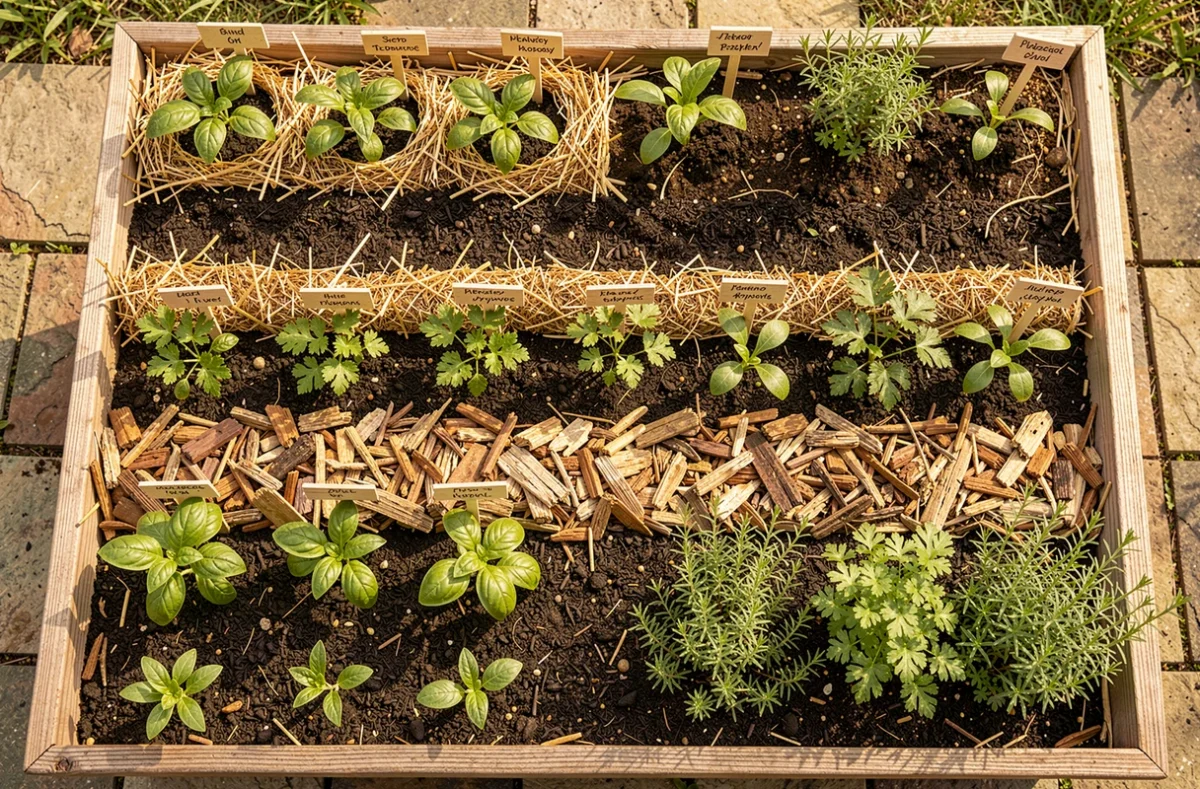
Typical structure for a well-heighted bed
- Bottom layer (one quarter to one third of the volume): shredded branches, small logs, hedge trimmings. This woody material decomposes over several years and feeds the soil fungi, which in turn improve the structure of the substrate.
- Intermediate layer: dead leaves, dried grass clippings, straw, unprinted brown cardboard. This mix balances the carbon/nitrogen ratio and retains moisture between waterings.
- Top layer (one third of the volume): a mix of topsoil and mature compost. This is the working zone for vegetable roots. Good compost smells like a forest, not ammonia.
The key point to remember: an excess of compost in the bed can lead to a buildup of phosphorus. The study by Small et al. (2024), which tracked urban gardens amended with compost over seven years, shows that excess phosphorus eventually leaches into the underlying soil. It is better to dose the input according to the crops rather than systematically replenishing every autumn.
Maintaining the substrate of a garden bed over the seasons
After one or two seasons, the level of the bed visibly decreases. One might think that the soil is exhausted and needs to be completely replaced. In reality, compaction is normal and does not justify a complete renewal of the substrate. The organic matter at the bottom has decomposed, releasing nutrients and creating porosity.
The best practice is to top up from above. A thin layer of mature compost, mixed with the top few centimeters of soil, is usually sufficient. It is advisable to avoid turning the bed deeply: microorganisms and earthworms have colonized the layers, and complete digging destroys this network.
Crop rotation in a limited space
In a garden bed, rotation is more challenging than in a large garden because the volume of soil is limited. Vegetables are grouped by family (nightshades, cucurbits, legumes) and their location is alternated from one square to another each year. Legumes (beans, peas) fix atmospheric nitrogen in the soil, benefiting the following nutrient-hungry crops, such as tomatoes or zucchinis.
A bed divided into four sections allows for simple rotation over four years. Placing legumes before nightshades measurably reduces the need for nitrogen fertilizer. If the space is very small (only one bed), at least alternate between demanding crops and frugal crops from one season to the next.
Choosing wood and protecting the bed: what changes for the soil
The material of the bed directly influences the substrate. An untreated wood frame (douglas, larch, chestnut) remains the safest choice for food crops. Treated wood can release undesirable substances into moist soil, especially with prolonged contact with acidic compost.
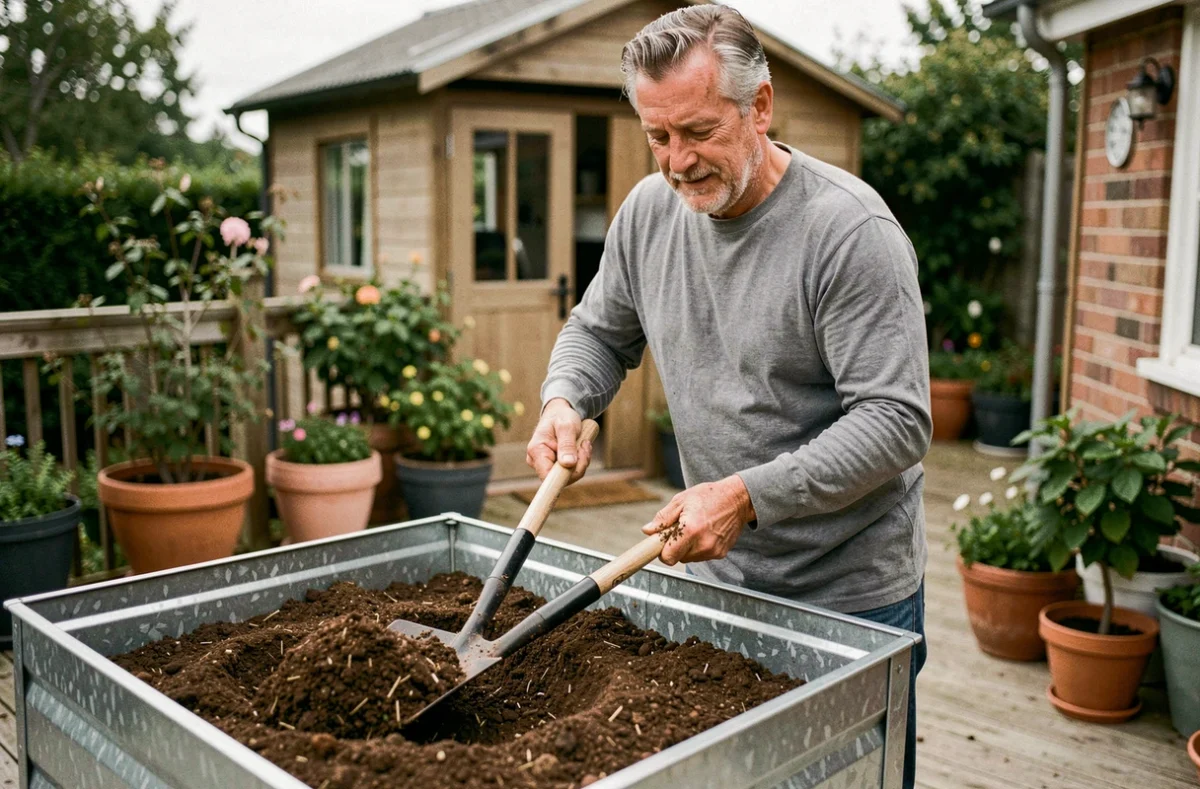
To extend the life of the wood without contaminating the soil, a geotextile felt can be placed between the walls and the substrate. This felt also limits the loss of fine soil particles through the gaps while allowing air and water to circulate. Galvanized steel beds, which are becoming increasingly popular, do not pose this problem and withstand the elements well.
A detail often overlooked: the height of the bed determines what can be grown in it. Root vegetables (carrots, parsnips) require a depth of loose substrate of at least thirty centimeters. Salads, radishes, and herbs require much less. Adapting the filling depth to the planned crops avoids wasting substrate in an oversized bed.
The raised garden bed is not complicated to fill, as long as one thinks in layers, doses the compost according to the actual needs of the plants, and does not start over every year. A well-constructed and properly filled bed yields results from the first season and improves over time if we let the life of the soil do its work.