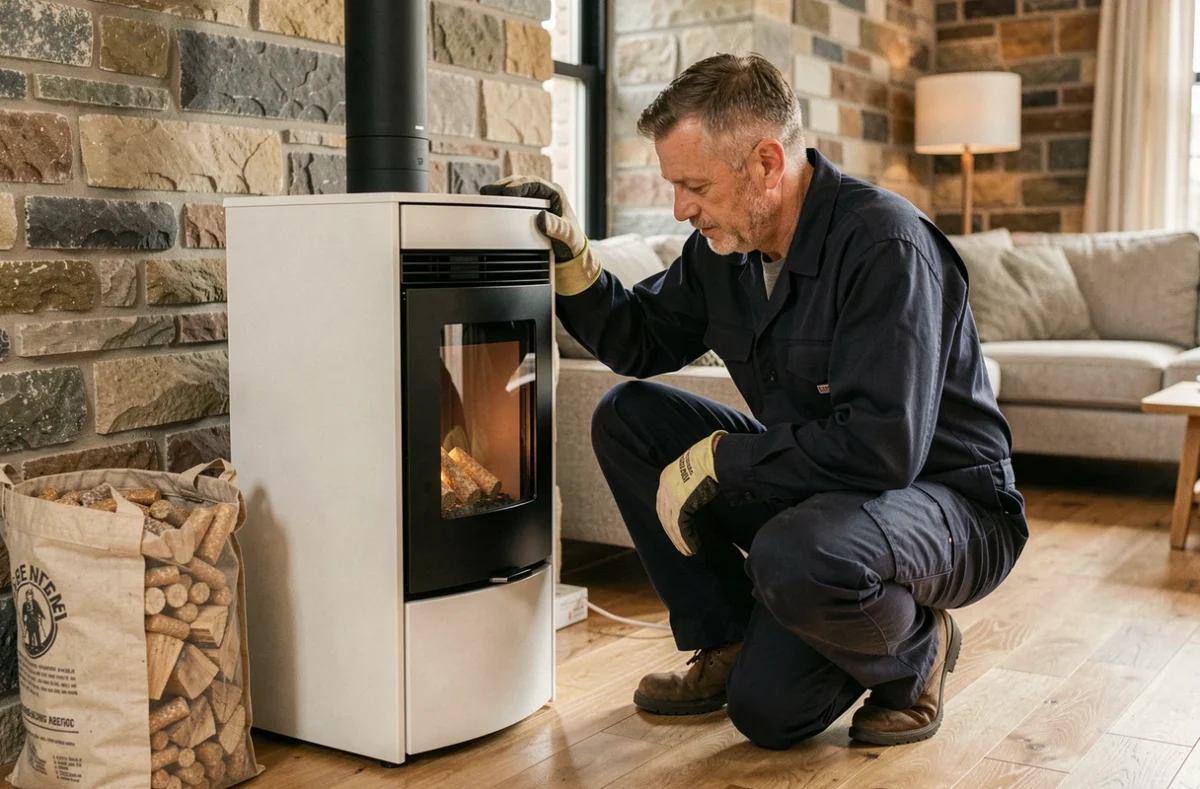
When replacing an old wood stove with a pellet stove, one expects a stated efficiency of over 90%. In reality, the situation differs: a study by ADEME conducted with INERIS, CSTB, Solagro, and Wigwam Conseil shows that some devices significantly lose efficiency at low power, a common operating mode in mid-season.
Carbon monoxide emissions increase under these conditions. Understanding these discrepancies between laboratory results and actual use changes the way one chooses their pellet heating.
Actual Efficiency of Pellet Stoves: What Changes at Partial Load
A pellet stove rarely operates at full power. In autumn or spring, it is often set to minimum to maintain a stable temperature without overheating. It is precisely in this partial load mode that performance deviates the most from the values announced by the manufacturer.
The ADEME/INERIS study highlighted that incomplete combustion at low power generates more pollutants and reduces actual efficiency. Specifically, a device rated at 92% nominal efficiency can drop well below that when running at idle for hours. For news on Pellet Heating, this finding prompts professionals to recommend precise sizing of the device relative to the volume to be heated, rather than oversized “for safety.”
Choosing a stove suitable for the actual surface area of the home remains the most effective lever to avoid prolonged operation at low power. A device that is too powerful for the room will spend most of its time running inefficiently, exactly where performance drops.
Standards and Labels for Pellet Heating: Ecodesign, Energy Label, and Flamme Verte
Three devices that do not measure the same thing are often confused. European ecodesign sets a minimum regulatory threshold for any device sold on the market. The energy label classifies devices by efficiency, from A++ to G. Flamme Verte, a voluntary French label, imposes more stringent criteria.
Since January 2025, the Flamme Verte reference includes emission measurements at partial load for new devices presented for labeling. This is a turning point: until now, only performance at full power was considered in the evaluation. This evolution directly addresses field observations regarding efficiency discrepancies.
Another technical change to be aware of: the series of European standards EN 16510 has replaced the old EN 14785 for pellet stoves, with the transitional period ending on November 9, 2025. When comparing two pellet stove models, checking which standard is listed in the technical sheet helps avoid comparing values obtained under different protocols.
- Ecodesign defines the legal minimum for market entry, it does not guarantee a high level of performance.
- The energy label ranks devices against each other, but does not reflect behavior at partial load.
- Flamme Verte, since 2025, also tests emissions at low power, providing a more accurate picture of actual operation.
Price of Pellets in France in Autumn 2026: Understanding the Increase
The pellet market has seen a significant increase in recent weeks. According to the Selectra barometer, the price of bulk pellets at TotalEnergies rose from 387 euros at the end of August to 426 euros in mid-September, and then continued to rise to 466 euros including tax by October 13, 2026. Over a month, this represents an increase of 78 euros per ton.
This autumn spike is not exceptional in its mechanism: seasonal demand concentrated over a few weeks drives prices up. Households ordering urgently before the first cold spells consistently pay more than those who plan ahead in late spring or summer.
Encouraging competition among local suppliers remains a concrete lever. Regional distributors sometimes offer prices significantly lower than those of large national groups, whose prices serve as a media barometer without reflecting the entire market. The choice between bulk and bags also weighs in: bulk is generally cheaper per ton, provided one has a suitable storage silo.
Wood Pellet Scams: Warning Signs to Spot Before Buying
The rise in wood fuel prices attracts fraudulent sites offering pellets at abnormally low prices. The DGCCRF has blocked several fake online sales sites in recent months. The pattern is often the same: a recent site, prices well below the market, payment by bank transfer only, and no delivery after ordering.
- Check the age of the site (recent creation = warning sign) and the presence of complete legal mentions.
- Beware of prices lower than one-third of the market average, especially during high demand periods.
- Prefer locally identifiable distributors, with a physical depot or verifiable reviews.
- Never pay by direct bank transfer without verifying the actual existence of the seller.
These scams take advantage of anxiety related to rising prices. Taking the time to compare several quotes from established suppliers offers better protection than a hasty order on an unknown site.
Local Restrictions on Wood Heating in France: What is Changing
Several French municipalities are now more strictly regulating the use of wood and pellet heating devices. These restrictions primarily target open fireplaces and older low-efficiency devices, not recent labeled pellet stoves. However, regulations vary from one area to another, particularly in regions classified as air protection zones.
Before investing in a pellet stove or boiler, it is advisable to check local prefectural orders. In some municipalities, the installation of an unlabeled device is simply prohibited, even when replacing an existing unit.
Pellet heating maintains a strong position among domestic renewable energies, provided one chooses a properly sized device, tested according to current standards, and purchases fuel from reliable suppliers. Vigilance regarding sizing and pellet quality has a greater impact on comfort and actual savings than the nominal efficiency displayed on a product sheet.