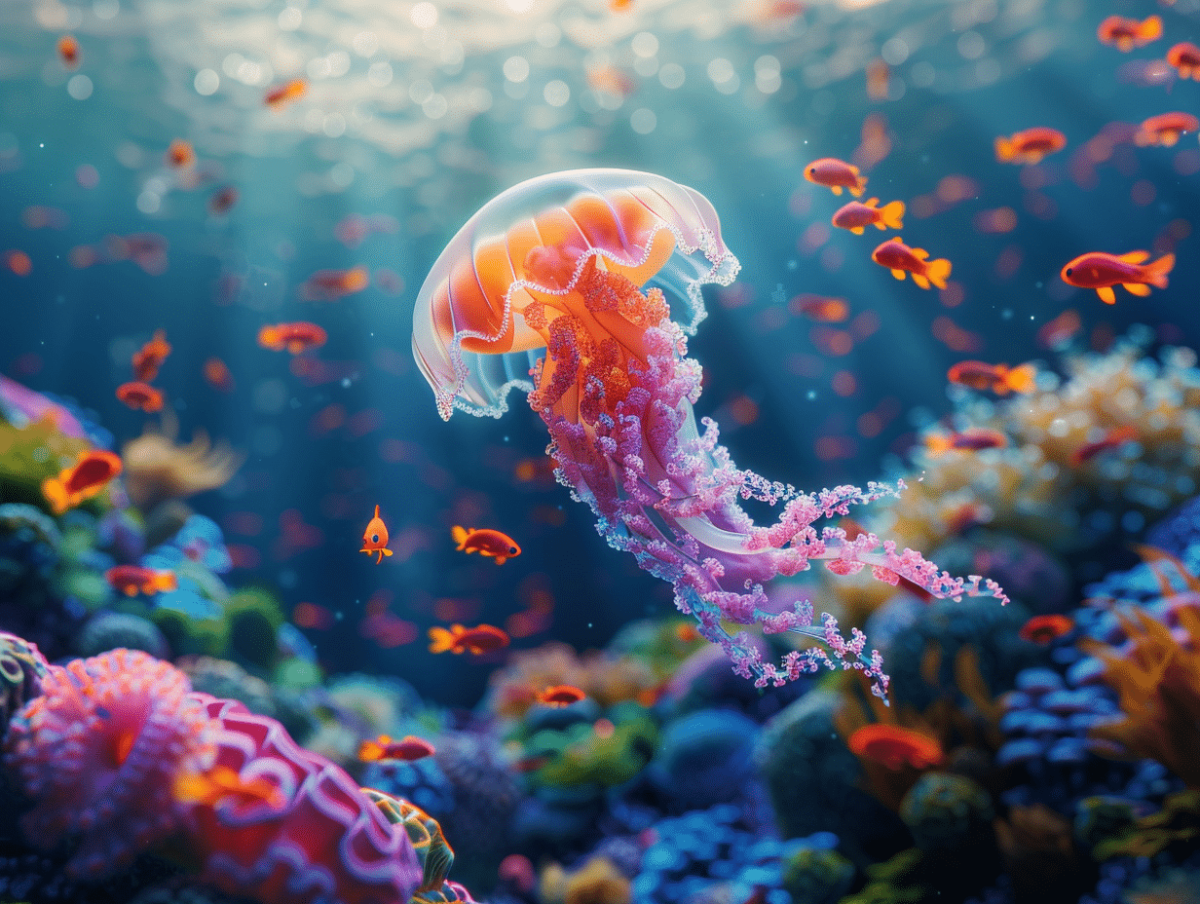
Oceans, covering more than 70% of the Earth’s surface, are home to fascinating creatures that often challenge our understanding. From the depths to coral reefs, marine wildlife reveals an unsuspected and sometimes strange diversity. The depths hide species such as the ogre fish, with its sharp teeth, or the giant squid, rarely observed by humans.
Scientists continue to discover new marine species, unveiling life forms with surprising adaptations. Bioluminescent jellyfish and transparent fish illustrate the richness and complexity of this ecosystem. Every dive into these mysterious waters promises new revelations.
The Mysterious Creatures of the Abyss
The abyss, these vast dark and oppressive expanses of the ocean depths, is home to enigmatic marine fauna. Among the most captivating creatures, the colossal squid stands out for its impressive size, reaching up to 14 meters. This giant of the depths maintains a conflicted relationship with the blue whale, their encounters being rare but spectacular.
The icefish fascinate with their unique characteristic: they have transparent blood, an adaptation to extreme temperatures. The phronima, on the other hand, inspired the design of the creature in the movie Alien. Their frightening appearance and predatory lifestyle make them all the more intriguing.
- Bioluminescent jellyfish illuminate the abyss with their bright flashes, using bioluminescence to attract their prey.
- Yeti crabs live in symbiosis with bacteria, exploiting this relationship to survive in hostile environments.
- Abyssal eels practice ambush hunting, camouflaging themselves to surprise their prey.
Abyssal biodiversity raises many scientific questions, particularly about the extreme adaptations of these creatures. Ragged-tooth sharks, for example, are often identified as sea serpents due to their elongated, undulating bodies. The existence of the coelacanth, long considered a living fossil, demonstrates the resilience and continuity of certain species.
The discovery of the Bogmoule, a recently identified crustacean, illustrates how the abyss remains a territory to explore. These creatures, which withstand unimaginable pressures and a complete absence of light, testify to the incredible diversity and adaptability of marine life.
The Fascinating Adaptations of Marine Fauna
In the abyss, where pressure is extreme and light is nonexistent, marine fauna has developed remarkable adaptations for survival. Bioluminescence, for example, is a common strategy among bioluminescent organisms. These creatures, such as bioluminescent jellyfish and giant-eyed fish, use light to attract their prey.
Giant squids deploy spectacular reproductive strategies, taking advantage of their bioluminescence to locate each other in the dark. Similarly, tube worms living near hydrothermal vents exploit symbiosis with chemoautotrophic bacteria to obtain their energy.
- Species
- Adaptation
- Bioluminescent jellyfish
- Use of bioluminescence to attract prey
- Giant squids
- Reproductive strategies based on bioluminescence
- Tube worms
- Symbiosis with chemoautotrophic bacteria
The food chain of the abyss is complex and interconnected. Cleaner shrimp, for example, participate in major symbiotic interactions for the health of marine ecosystems. They rid fish of their parasites in exchange for food.
Overfishing, pollution, and climate change threaten abyssal biodiversity. Hammerhead sharks and bluefin tuna have also faced intense pressures due to these factors. Their speed and adaptability, while remarkable, are no longer sufficient to compensate for anthropogenic impacts.
The ability of these species to adapt to extreme challenges remains a lesson in resilience, but it also underscores the need to protect these unique marine ecosystems.